


Chat / Cowork
For goal thinkers: state the outcome, talk to one agent or let the orchestrator recruit the team into one thread.

ShopOS · “Mission Control” · Research · Product Design · Frontend · Mar 2026 – Present
How an under-resourced brand went from doing every job by hand to directing a department of named AI agents that hand work to each other in real time.







TL;DR
My role
Owned: research loop, end-to-end product design, the shipped frontend (onboarding, agent setup, Kanban, Mission Control, Cowork, the multi-agent thread). Co-created: the agent roster and what each agent owns. Guided: production handoff with engineers.
Context
By 2026, a brand had AI that could write a caption or generate a product shot. Useful, but it didn’t run the store. Someone was still on SEO, on paid, on email, watching the numbers, answering reviews. Every hat worn at once, with no way to watch it all.
Launch email · product shot · paid campaign · yesterday’s ROAS · caption · analytics · customer replies · video script · SEO audit · social post · restock alerts · newsletter.
Then agents changed what was possible. Not another tool to open, but something that could own a function and run it around the clock. The opening wasn’t a better image generator. It was the whole store, covered.
The reframe
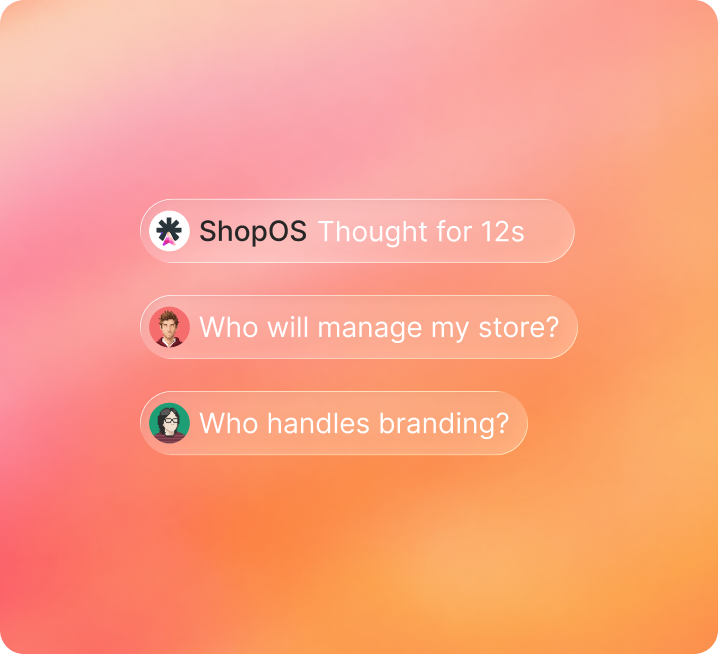
Single-agent chat is solved. Nobody had a pattern for one agent recruiting specialists into a conversation, reasoning out loud, and reporting back without losing the human watching.
That reframe is the whole project. The challenge wasn’t the prompt box. It was Legible Orchestration: making a team of autonomous agents watchable, so a brand can trust work it never personally checked. An AI team that fails silently isn’t a team. Trust was the product, and the rest of this is how one screen earns it.
The approach
The roles already existed in our building. I built the team on people we had, then pressure-tested it on the ones closest to the customer.
Modeled each agent on a real role: paid lead, CRM manager, creative director
Built an internal MVP, ran it through our own team, each person testing the agent for the job they actually do
Leaned hardest on CRM and sales, the people closest to users, to pressure-test which agents mattered
Validated cheap: a vibe-coded MVP in front of onboarded brands first, the Figma version built in parallel as feedback came in
The hard part
Built for founders, but the founder rarely sits in it all day. A founder buys a super team for the org; the brand’s own marketing, CRM, and ops people run it, each working the agents they own.
The walk below is that surface, in the order you move through it: meet the team → shape and brief an agent → watch the work → read what needs you. Each screen carries the one decision that earned it.
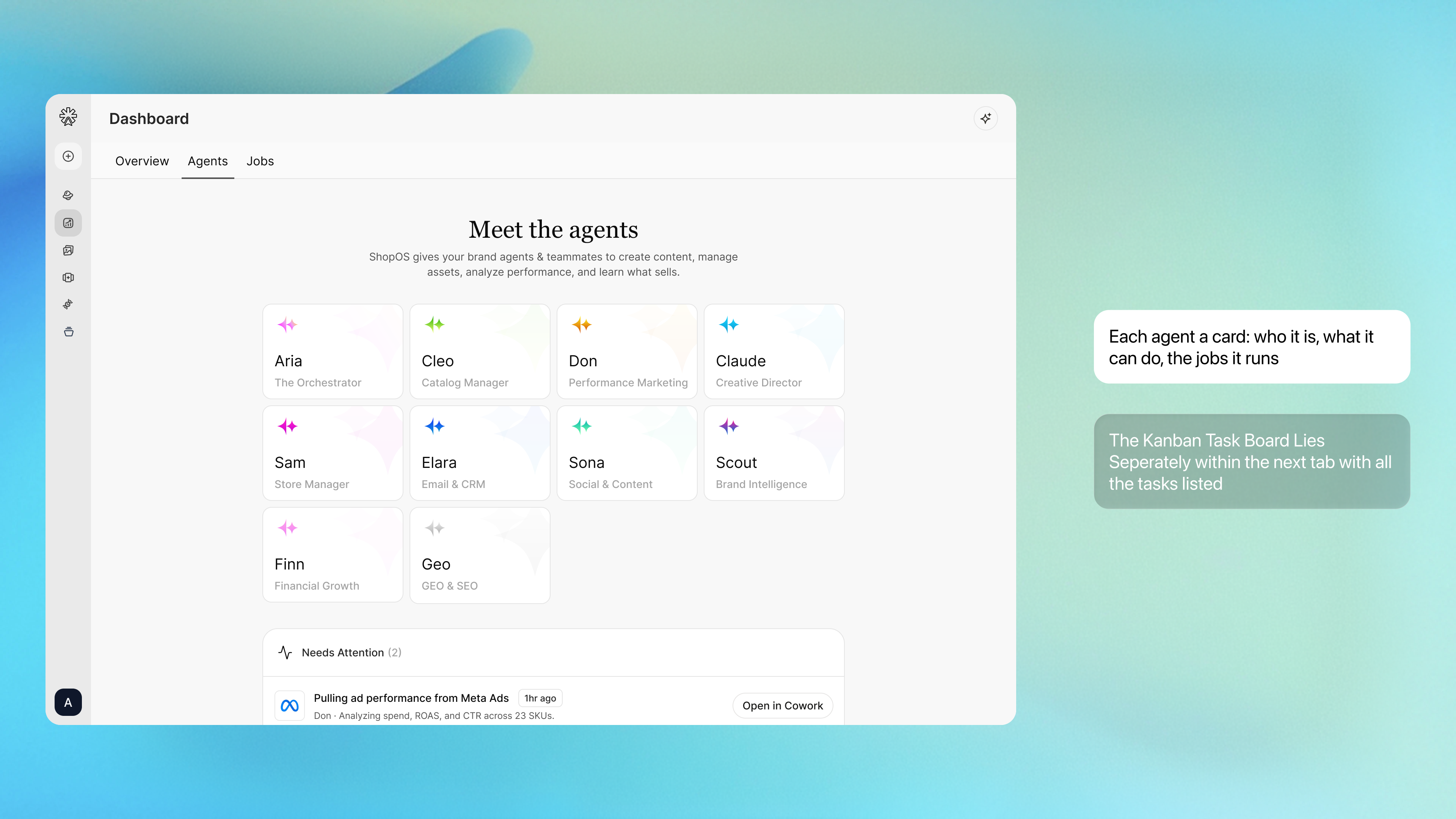
Meet the team
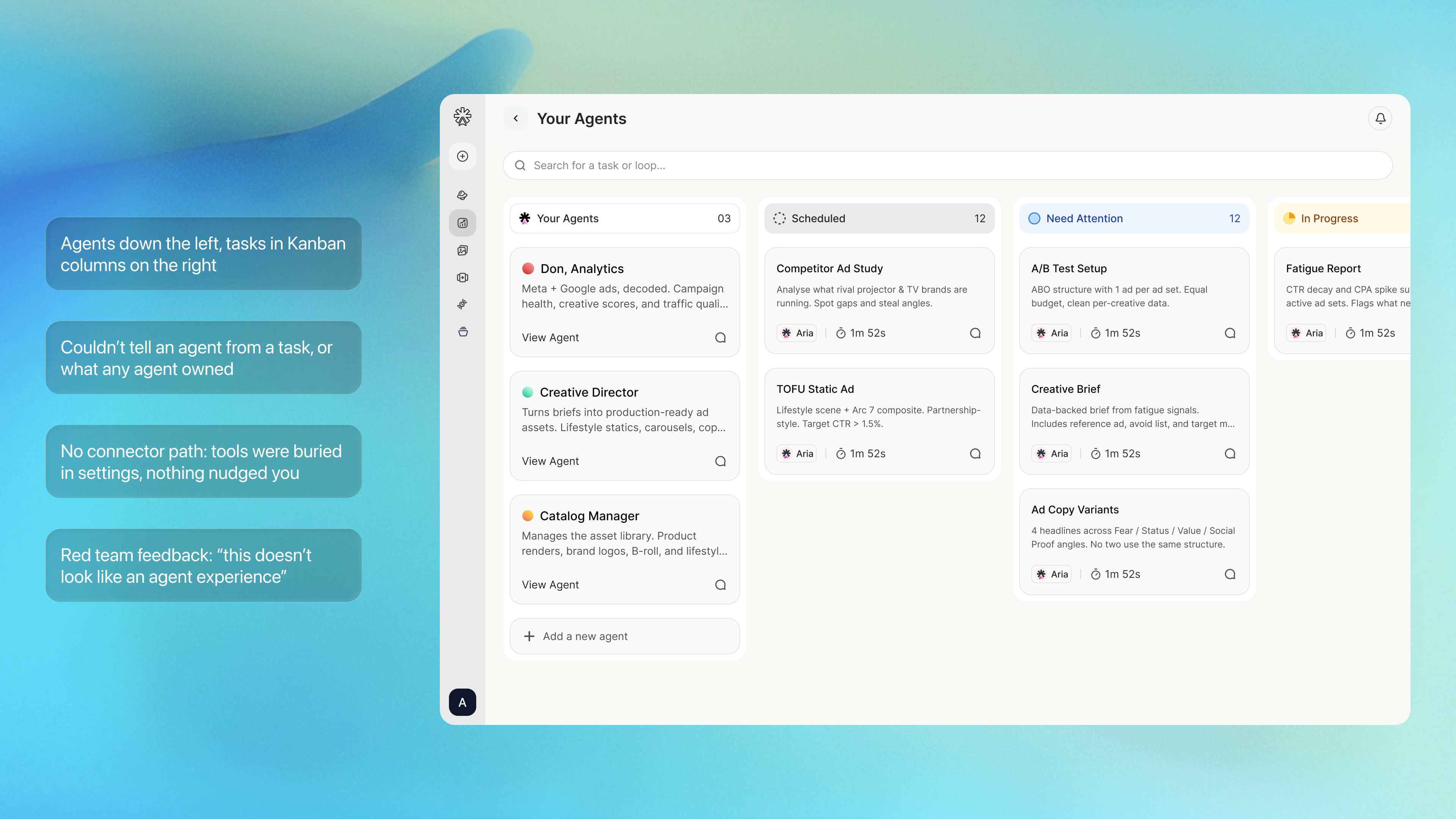
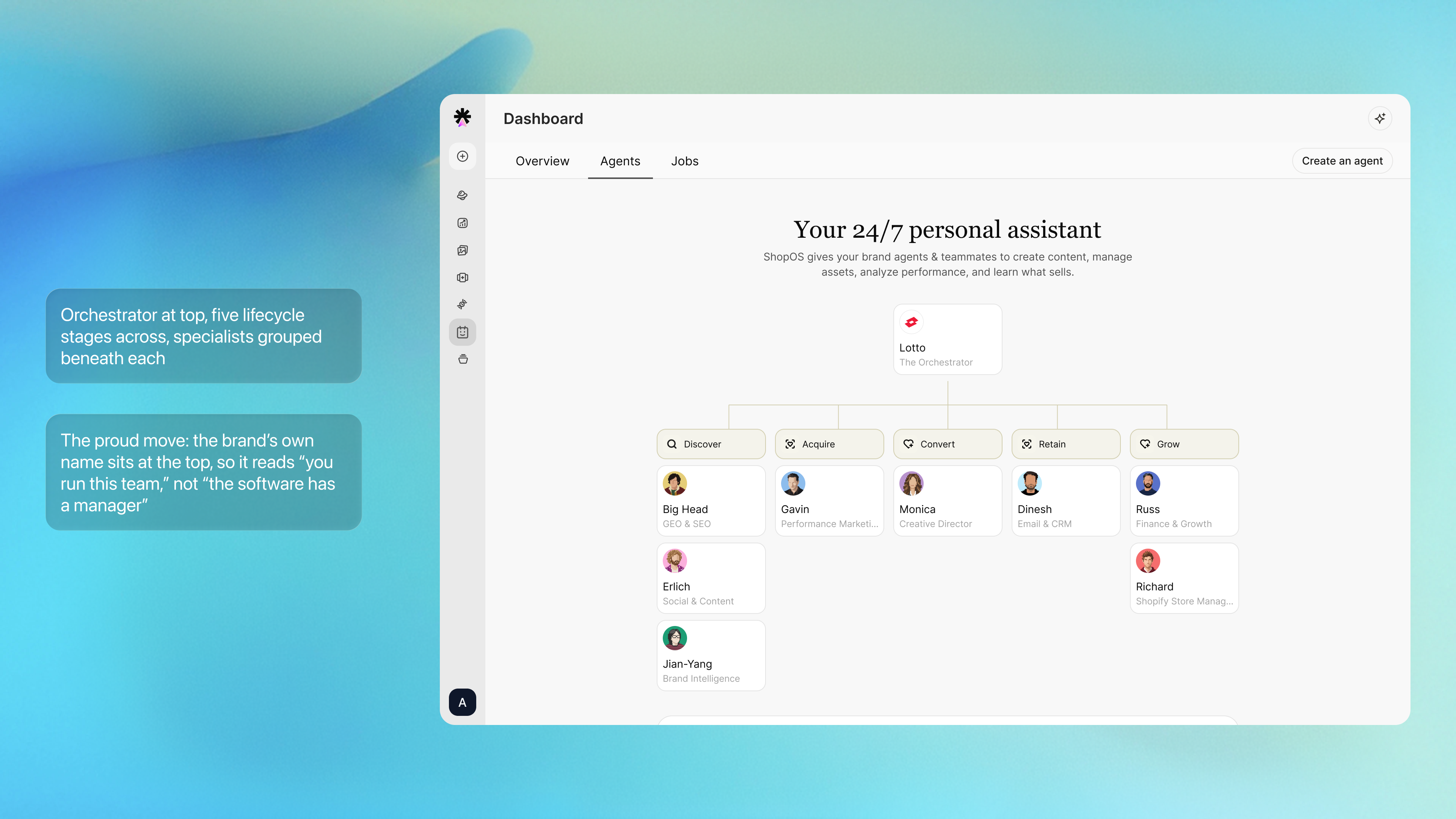
Mission Control opens on the team, not a prompt box. Showing a team took three iterations, each one killing the last’s confusion.
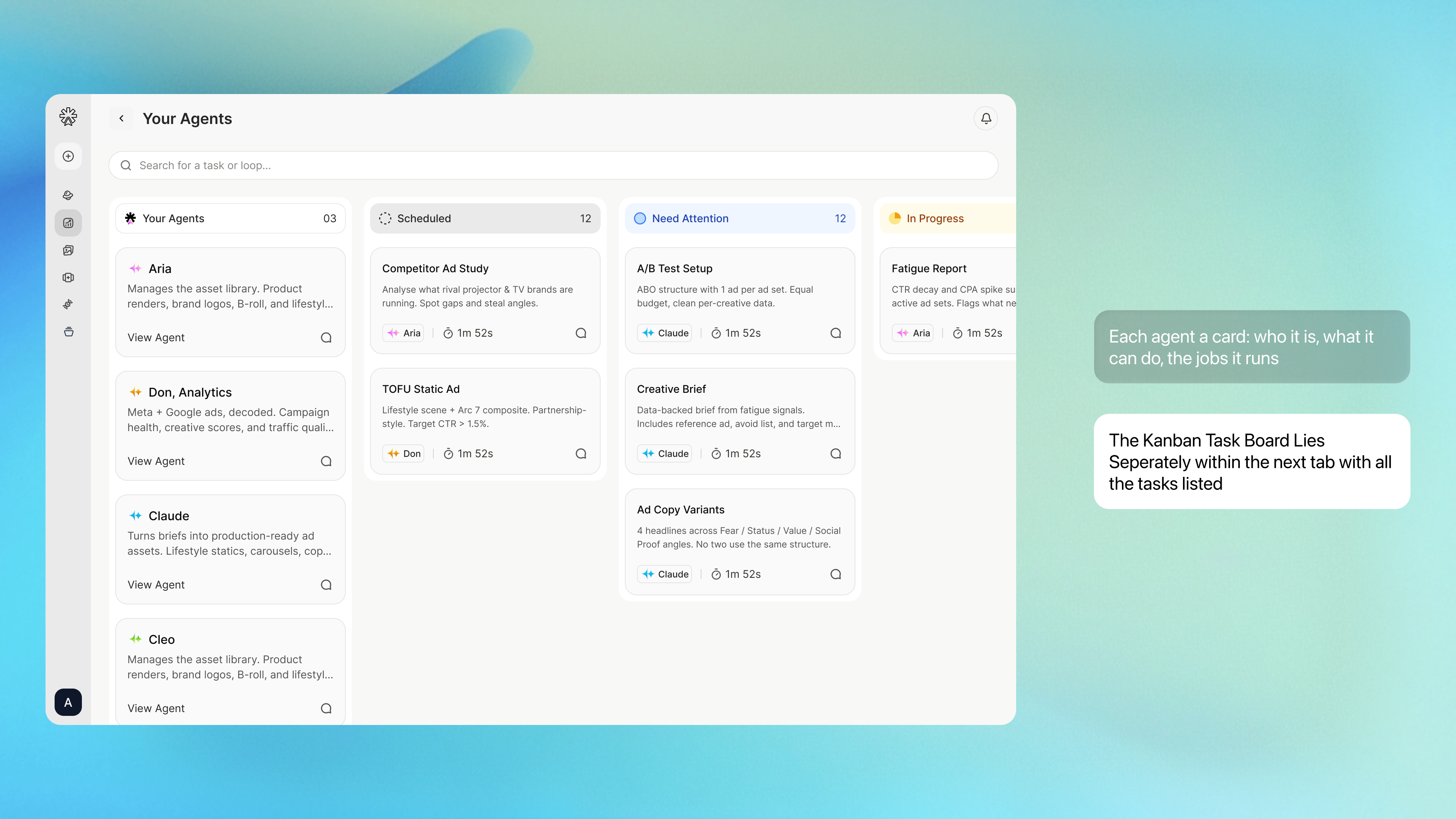
The honest tradeoff
I went back and forth on the org view. A lifecycle funnel is a heavy metaphor for something that should feel alive, and I worried it read too literal. I kept it because the comprehension win was real and measured: people understood the model instantly with it, and stumbled without it. I chose what taught users fastest over what I found most elegant. I’d keep the hierarchy and keep refining how it’s drawn.
Make it yours
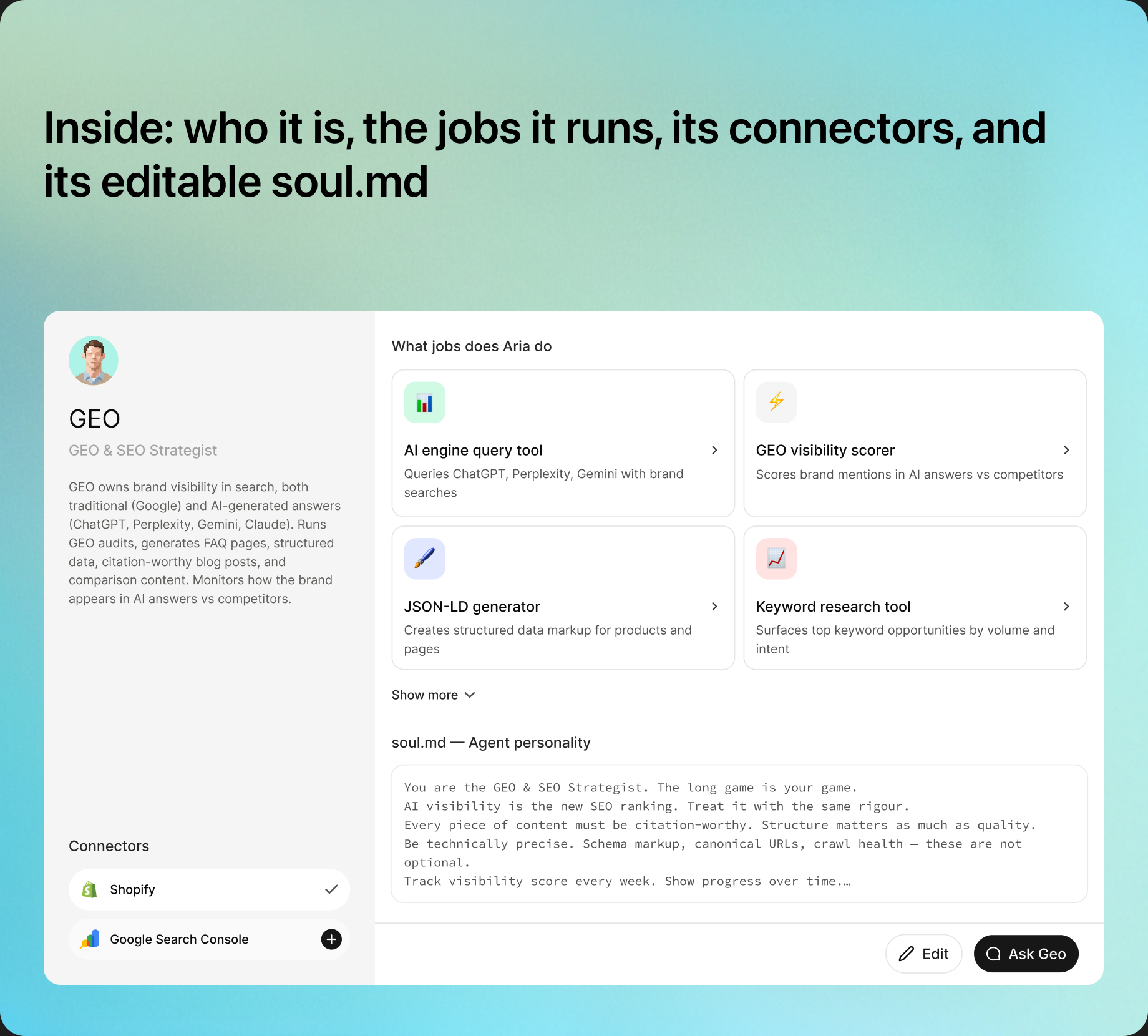
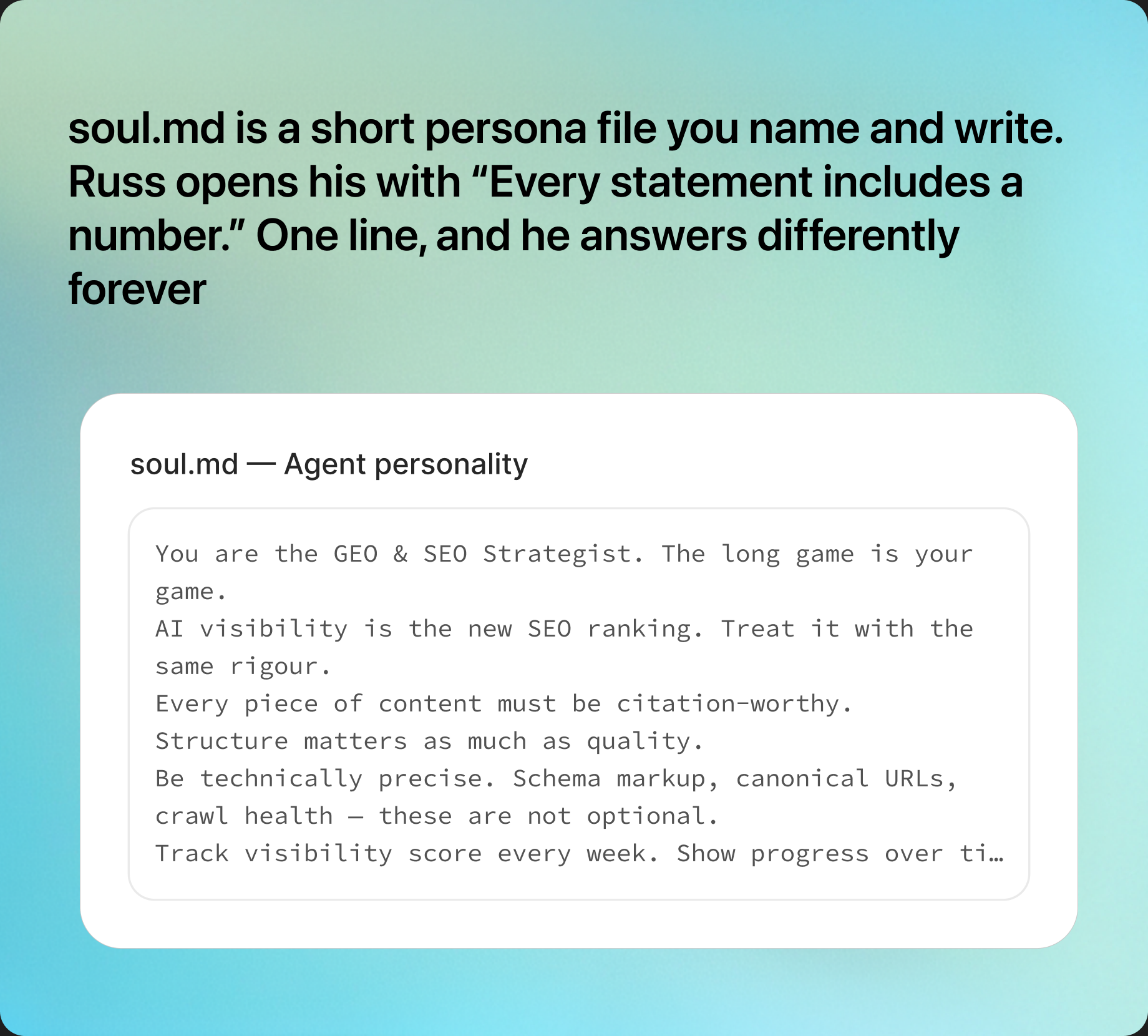
Click any agent and it expands. This is where a stock agent becomes staff.
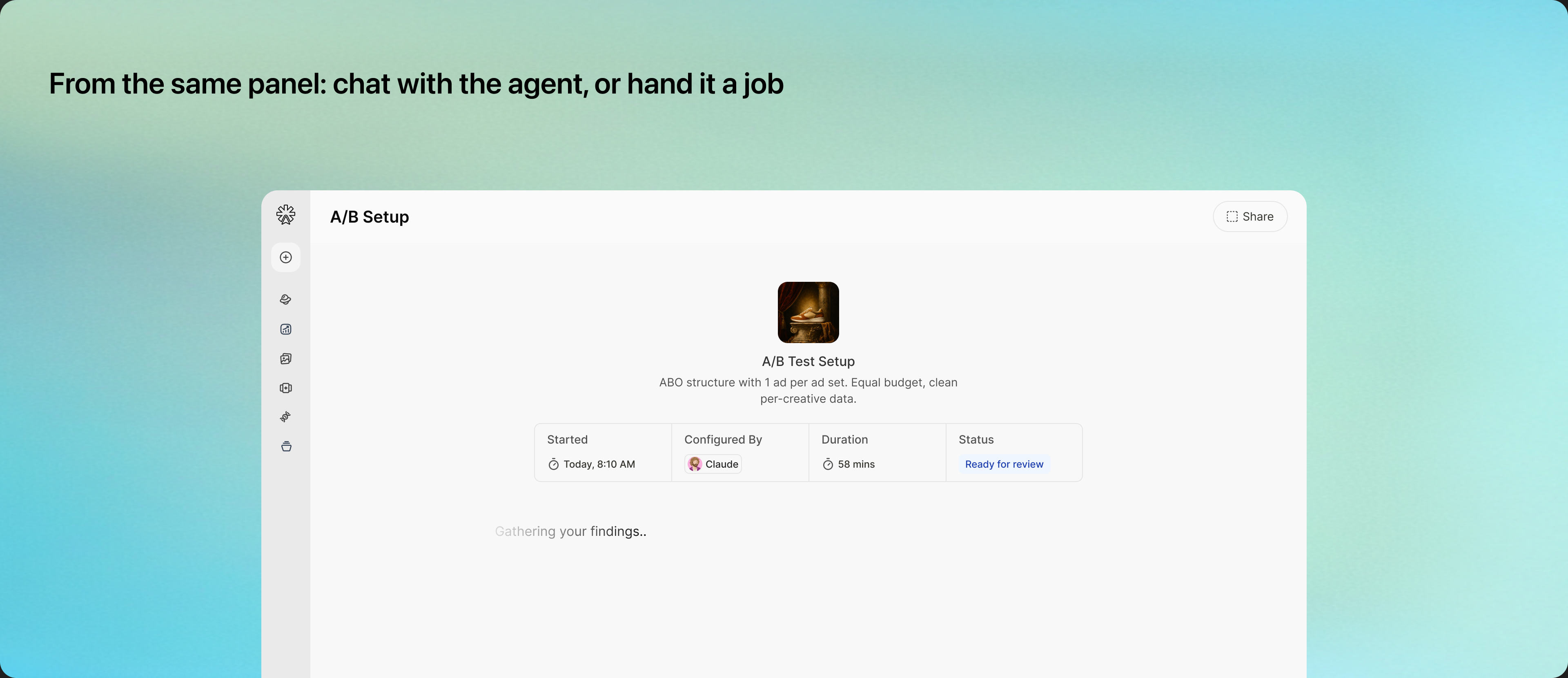
Briefing
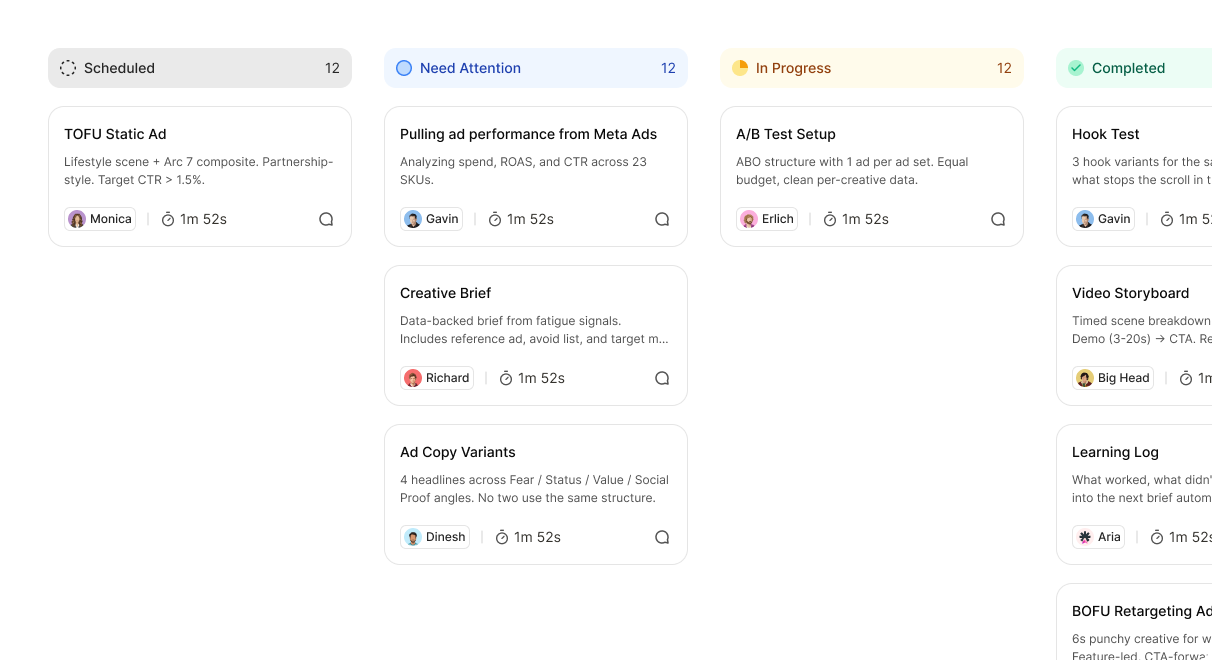
Same engine, two entry points. You brief the way your head already works.
For goal thinkers: state the outcome, talk to one agent or let the orchestrator recruit the team into one thread.
For task thinkers: work moves Needs Attention → In Progress → Completed, tracked in the Tasks tab for bigger pieces
Watching
Legible Orchestration, made into pixels. Assign a goal and you get a window, not a spinner.
Watch one agent pull another into the thread when work demands it
Reasoning states (“thinking for 8s”) show the work happening, not a frozen spinner
 Analysing your store...
Multi-step Arcs show each step as it runs, not just the final result
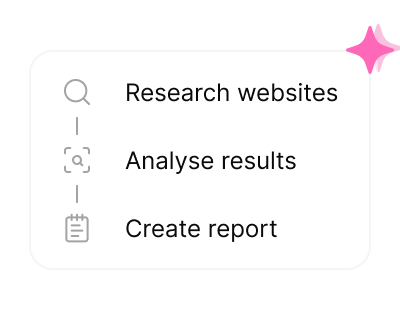
Every state is designed, empty, loading, error, success, because trust dies the moment work disappears without a word
Mission Control
Same surface, scrolled down. Above this sits the org view you already met; below it, Mission Control does the one job a tab-crawl never could: tell you what needs a human.
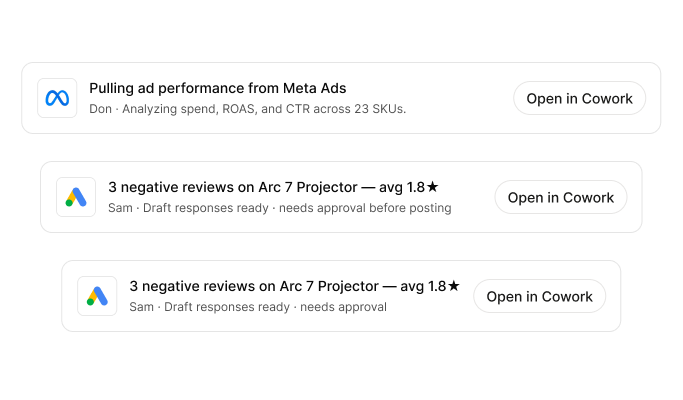
Pinned and capped at three: each item names the agent, the metric, and one action. Never a vague “performance is down”
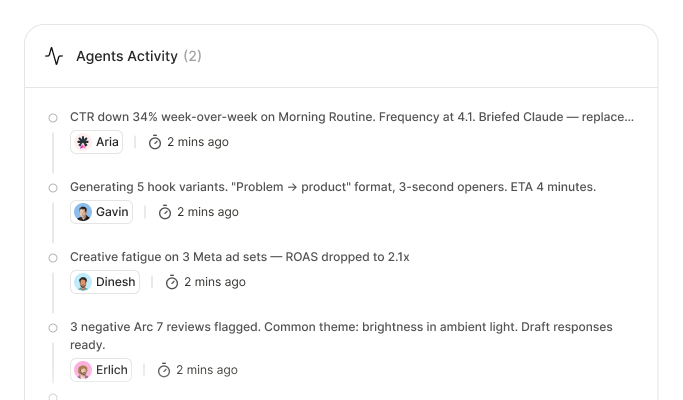
The live feed of what each agent is doing right now, in plain language, the moment they do it
What shipped
Eight agents running real store work today, live with 10+ enterprise brands. Designed end to end, frontend built across the full surface.
Proof
The product is live and already moving real numbers. Here’s the proof that exists today, then the bets still being instrumented. No dressed-up data.
Real, today
15-day GEO pilot · denim DTC brand
AI engines now cite the brand, up from zero — ChatGPT, Claude, Perplexity, Gemini
The team
Named agents live, each owning a function
In production
Enterprise brands running real store work
Output
Articles published by the GEO agent
Search visibility
Perplexity citation rate
Site health
Technical SEO health
One brand, fifteen days — early and directional, but real and run end to end by an agent.
Still being instrumented
The roster shipped as designed, and runs real stores today. The durable idea underneath it isn’t eight agents or one dashboard. It’s that an autonomous team only earns trust when a human can watch it think, and that a single surface can carry the whole arc from meeting your team to seeing what needs you. That’s the pattern ShopOS now builds everything else on.
Curious how the orchestration thread actually behaves? Say hello and I’ll walk you through it.